
There are many diseases that can mar or disfigure a person’s skin. Why does the Torah focus so much on the disease called (in Hebrew) tzara’at?
In this article I will focus on one aspect of the Torah’s discussion about tzara’at.
45. And the the person with tzara’at in whom the mark is, his clothes shall be torn, and his hair shall be grown out, and he shall cover his upper lip, and shall cry, “Unclean, unclean.”
46. All the days that the mark is on him he shall be unclean; he is unclean; he shall dwell alone; outside the camp shall his dwelling be.
The Affliction of Tzara’at
Tzara’at can appear on person’s body, clothing, or house.
The word “tzara’at” is often translated as “leprosy.” However, that is not a proper translation. Rabbi Samson Raphael Hirsch in his commentary of Leviticus 13 discusses in detail the differences between tzara’at and leprosy.
I explained some of those details in a previous article.
Leviticus 13:1-44 explains the affliction of tzara’at and how it may appear on different parts of the human body. The priests are given procedures to follow to decide if a person has tzara’at.
Also, several skin conditions that could be mistaken for tzara’at are explained in the chapter.
In this article I will explain Leviticus 13:45-46. These verses are about the beginning of the healing process for a person suffering from tzara’at. The rest of that process is explained in Leviticus 14.
Leviticus 13:45-46 come directly after the Torah explains tzara’at of the head. That could imply that only a person with that form of tzara’at must follow these stringencies.
However, the Jewish sages have taught that these verses apply to tzara’at on any part of the body.
Leviticus 13:45
and he shall cover his upper lip – like a mourner [Rashi].
Rabbi Steinsaltz explains that in the past it was a standard mourning practice to cover the face. For example, this is what King David did on 2 occasions:
15:30. And David went up by the ascent of the Mount of Olives, and wept as he went up, and had his head covered, and he went barefoot …
19:5. But the king covered his face, and the king cried with a loud voice, O my son Absalom, O Absalom, my son, my son!
and shall cry, “Unclean, unclean.” – I came across 3 explanations for why the person is required to cry out.
1. Onkelos writes that he is warning people to stay away from him so that they will not become unclean. The afflicted person cries out to protect other people.
2. The Gemara explains that he cries out for help:
and shall cry, “Unclean, unclean.” – [this teaches that] one must needs make his distress known to many, that many pray for mercy on his behalf.
Torah Temimah comments that this explanation is based on the word “cry” [Hebrew root: kuf-reish-aleph]. This root is usually translated as “call” but can also mean to announce or publicize.
3. Rabbi Dessler (Michtav MiEliyahu, Vol. 3, page 173) explains the person cries “unclean, unclean” so that his mind will not be distracted from his need to repent of his sins that caused him the affliction of tzara’at.
In this explanation, his crying out is to arouse himself to repentance.
Leviticus 13:46
he is unclean; he shall dwell alone – Rabbi Sorotzkin explains the reason the person afflicted with tzara’at must dwell alone is because he is unclean. It’s not because his affliction is a type of contagious disease. If it was just to prevent the spread of disease, then he could be quarantined is a house or tent.
Rashi adds that not even other afflicted people should dwell with him.
How is he different from other unclean people? By speaking “lashon hara” he caused divisions between a man and his wife, or between a man and his friend. So too, he should be separated from others. (In Hebrew, speaking against someone in a slanderous or disparaging way is called “lashon hara,” literally “evil speech.”)
The midrash lists 10 reasons why a person may be afflicted with tzara’at. You can see that list here. Even so, it is often accepted that speaking lashon hara is a main cause of tzara’at.
outside the camp – outside of all three camps [Rashi].
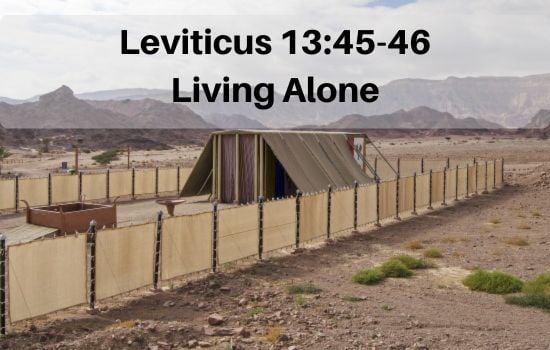
When the Jewish people were in the wilderness, they pitched their tents around the Tabernacle. The area they occupied was divided into three camps listed here in descending order of holiness:
- camp of the Divine presence – the area of the Tabernacle.
- camp of the Levites – around the Tabernacle where the priests and the rest of the tribe of Levi lived.
- camp of Israel – where the rest of the Jewish people lived.
Rabbi Hirsch explains the person afflicted with tzara’at suffers a greater removal than all other unclean people.
The person who is unclean due to contact with a dead person is only excluded from the camp of the Divine presence.
A man or woman who has the status of a zav or zavah is also excluded from the camp of the Levites. (The status of a zav and zavah is explained in Leviticus 15.)
R. Steinsaltz notes that after the Jewish people entered the Land of Israel, the person afflicted with tzara’at would live alone outside the city walls.
People with Tzara’at
We find several instances in the Bible of people afflicted with tzara’at.
Miriam
The episode with Miriam speaking against Moses is found in Numbers 12.
1. And Miriam and Aaron spoke against Moses …
10. And the cloud departed from off the Tent; and, behold, Miriam was afflicted with tzara’at, white as snow …
As a result of this episode, she was quarantined outside the camp for 7 days (Numbers 12:14-15).
The Afflicted Four
The narrative in 2 Kings mentions an incident involving four men with tzara’at.
3. And there were four men afflicted with tzara’at at the entrance of the gate; and they said one to another, Why should we sit here until we die?
Due to the tzara’at they were not permitted inside the city.
King Azariah
King Azariah reigned over the kingdom of Judah for 52 years.
In 2 Chronicles 26:16-21 (where is he called Uzziah) it’s recorded that he became haughty and tried to serve as a priest in the Temple.
His punishment was to be afflicted with tzara’at.
5. And the Lord struck the king, so that he was afflicted with tzara’at to the day of his death, and lived in a separate house. And Jotham the king’s son was over the house, judging the people of the land.
We see that once afflicted with tzara’at he was quarantined and no longer able to manage the affairs of the kingdom.
Conclusion
In the past, God used the affliction of tzara’at to make a person aware of failings in his or her life.
The person with a confirmed case of tzara’at was required to separate from society.
The practices described in Leviticus 13:45 (torn clothes, uncut hair, covering the face) are similar to what a person does to mourn the death of a relative.
Chizkuni writes that in fact the person with tzara’at should mourn over his past actions. Due to his evil actions this affliction came on him.
As Rabbi Dessler suggests, these practices should bring him to repentance.
His only cure can come from repentance. That is why the person with tzara’at interacts with the priest who should be a spiritual guide for him. A physician is not called in to treat this spiritual affliction.
Further Reading
Click here for a summary of Parshat Tazria.
Why does the Torah make a distinction between the birth of a son or a daughter?
You can read more about Miriam here.