

Jacob on his deathbed blesses his son Judah that his sons will be kings over the Jewish people “until Shiloh comes.” What is the meaning of Jacob’s blessing?
Here is the relevant verse:
10. The staff shall not depart from Judah, nor the scepter from between his feet, until Shiloh comes; and to him shall the obedience of the people be.
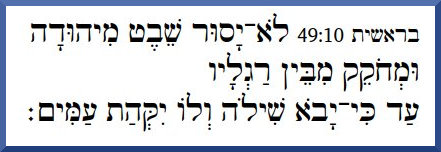
The word “staff” is the translation of the Hebrew sheivet (shin-bet-tet). The word “scepter” is the translation of the Hebrew m’chokeik (mem-chet-kuf-kuf).
As we will see, the commentators suggest different ways to understand these terms.
Genesis 49:10 – Overview
Let’s start by looking at how commentators understand this verse, other than the word “Shiloh.” Then I will look at several explanations of “Shiloh.”
The staff shall not depart from Judah
Rashi: from King David and onward. These are the heads of the diaspora in Babylon.
According to Rashi, the word “staff” means any appointed ruler. As we will see, Ramban disagrees with this understanding.
Radak: “staff” means the person exercising authority over a group. This is because the ruler often holds a staff in his hand.
nor the scepter from between his feet
Rashi: students. These are the leaders in the Land of Israel.
Radak: the offspring of the ruler, because sons come out from between the legs. The ruler is called “m’chokeik” because he is the one who can impose a decree (Hebrew: chok) on the nation.
and to him shall the obedience of the people be
Rashi: a gathering of nations to him.
Now let’s look at how to understand what Jacob meant by Shiloh.
Shiloh is a Person
Many commentators understand that Shiloh is a person. But they don’t all agree on who that person is.
Shiloh is Messiah
This is the understanding of Onkelos. Here’s how he translates Genesis 49:10 (by Rabbi Jack Abramowitz The Complete Targum Onkelos):
Genesis 49:10 One who wields authority will not depart from the house of Yehuda, nor a scribe from his children’s children, forever, until Moshiach comes because the kingship is his and nations will heed him.
Rabbi Saadia Gaon hints at messiah cryptically: “until there comes this one who it belongs to.”
Rashi writes explicitly: King Messiah because the kingship is his. Rashi understands “Shiloh” to mean “there is to him” [Hebrew: sh’lo, shim-lamed-vav].
Shiloh is Ahijah
Baal HaTurim (Rabbi Yaakov ben Asher) usually focuses his commentary on unusual words and gematria. On this verse, in addition to some gematria, he shares his idea of Shiloh’s identity.
He writes (my translation): Shiloh is [the prophet] Ahijah the Shilonite who was from the city of Shiloh. He announced to Jeroboam that David’s kingdom would be torn and Jeroboam would be given 10 tribes to rule. See 1 Kings 11:29-31.
Shiloh is a Place
This approach is adopted by Rashbam and Chizkuni. Here is my summary of Rashbam:
Shiloh in this verse is not a reference to a person. Rather, it means the city Shiloh which is north of Jerusalem and not far from Shechem.
He understands the phrase to mean, “until Judah comes to Shiloh.” In particular, this is a reference to the division of the Jewish people into two kingdoms after the death of King Solomon.
His son, Rehoboam went to Shechem to be crowned king (1 Kings 12). He alienated the people and the result was 10 tribes split from Judah and crowned Jeroboam as king of Israel which became the northern kingdom.
According to Rashbam, this split is the staff departing from Judah.
Ramban Explains – It’s a Commandment
All of the commentators that I’ve mentioned so far interpret Genesis 49:10 as only a prophecy.
Ramban disagrees and explains the verse as a command.
Also, as mentioned above, Ramban disagrees with Rashi and explains the word “staff / sheivet” means kingship. This term applies only to the king and not any other appointed ruler.
What the Verse Does Not Mean
The verse does not mean that kingship will never depart from Judah.
36. The Lord shall bring you, and your king which you shall set over you, to a nation which neither you nor your fathers have known…
This verse teaches that the Jewish people and their king will be exiled if they sin. As a result, there will no longer be a Jewish king over the people.
In addition, before Saul and David, there were many years when there was no king over the Jewish people.
Jacob was not trying to assure his sons that if they appointed a king from the tribe of Judah that they would not go into exile.
What the Verse Does Mean
The staff shall not depart from Judah – to another of his brothers. Rather, the king of Israel who rules over them must come from Judah.
nor the scepter from between his feet – Ramban understands “scepter / m’chokeik” it to mean the king who commands laws upon the nation.
The phrase “shall not depart” also applies to this phrase.
The phrase “from between his feet” is a reference to his sons who come after him and will also rule.
until Shiloh comes – Ramban agrees with Onkelos and Rashi that this is a reference to Messiah who will come at some future time and will be obeyed by all nations of the world.
What is his [the Messiah’s] name? — The School of Rabbi Shila said: His name is Shiloh, for it is written, “until Shiloh comes.”
Jacob’s Purpose
Genesis 49:10 hints that Jacob elevated the tribe of Judah to kingship over his brothers. This means that whenever there is a king over the Jewish nation, that king should come from Judah.
Ramban adds that the kingship is an inheritance of the tribe of Judah. Once David became king all other kings should come from Judah. Even if there is a time without a king, when the monarchy is restored, that new king should be from the tribe of Judah.
David declared that Jacob was speaking words of prophecy:
4. But the Lord God of Israel chose me [David] before all the house of my father to be king over Israel forever; for He has chosen Judah to be the ruler; and out of the house of Judah, the house of my father…
King Saul
Ramban understands the phrase “shall not depart” as a hint that there would be a king from a tribe other than Judah.
In fact, before David became king, Saul of the tribe of Benjamin was crowned king.
However, once David was crowned, then the kingship should not depart from Judah.
Why did God command the prophet Samuel to anoint Saul as king (1 Samuel 9:15-17)? Why wasn’t someone from Judah chosen at that time?
According to Ramban, the Jewish people’s request for a king during the lifetime of Samuel was not appropriate. As God told Samuel, their request was a rejection of God (1 Samuel 8:7).
Therefore, God told Samuel to anoint Saul who would be a “temporary” king. When Saul failed as king, he and his sons who might have reigned after him were killed in battle (1 Samuel 31:6).
This episode is summarized by the prophet Hoshea:
11. I gave you a king in My anger, and took him away in My wrath.
Saul’s Dynasty
1 Samuel 13 records an event when Saul demonstrated weakness and a lack of leadership. Samuel rebuked him:
13. And Samuel said to Saul, You have done foolishly; you have not kept the commandment of the Lord your God, which He commanded you; for now the Lord would have established your kingdom upon Israel forever.
Samuel’s rebuke implies that Saul could have established a lasting dynasty even though he was not from the tribe of Judah.
Ramban explains that Saul’s family could have continued as a dynasty ruling over part of the Jewish people. David and his descendants would have ruled over the majority of the tribes with the remainder given to Saul. (The Hebrew in 1 Samuel 13:13 can be read to imply ruling over a part of Israel, but not all of Israel.)
The Kings After David
According to Ramban’s approach, after David became king, no one from another tribe should be made king.
Yet we see that after the death of King Solomon that the kingdom was divided and Jeroboam from the tribe of Ephraim became king over 10 tribes.
The ascension of Jeroboam to the throne was prophesied and permitted by God (1 Kings 11:29-31). However, Ramban contends that anyone not from Judah who reigned after Jeroboam transgressed the command of Jacob.
He quotes this verse to support his contention:
3. Israel has cast off the thing that is good; the enemy shall pursue him.
4. They have set up kings, but not by me …
Ramban also criticizes the Hasmoneans who ruled as kings during the restored Second Temple after the Chanukah miracles. They were priests from the tribe of Levi.
He develops this idea in detail, but I will save that for a different article.
Further Reading
Click here for a summary of Parshat Vayechi.
Who is the redeeming angel that Jacob mentions when he blesses Joseph’s sons?