
Genesis 46 tells how Jacob and his family were reunited with Joseph in Egypt. A short time later, Joseph brings his father to meet with Pharaoh.
The meeting between Jacob and Pharaoh as recorded in Genesis 47 was short.
7. And Joseph brought in Jacob his father, and presented him before Pharaoh; and Jacob blessed Pharaoh.
8. And Pharaoh said to Jacob, “How old are you?”
9. And Jacob said to Pharaoh, “The days of the years of my pilgrimage are a hundred and thirty years; few and evil have the days of the years of my life been, and have not attained to the days of the years of the life of my fathers in the days of their pilgrimage.”
10. And Jacob blessed Pharaoh, and went out from before Pharaoh.
Questions
Each of these four verses raises a question to be answered.
1. What was Jacob’s first blessing for Pharaoh?
2. Why did Pharaoh ask Jacob’s age?
3. Why is Jacob’s answer so convoluted?
4. What was Jacob’s second blessing for Pharaoh?
Genesis 47:7 – Jacob Blesses
What was Jacob’s first blessing for Pharaoh?
Rashi writes that Jacob said a general greeting of asking about his health. This is the practice of any person who comes before a king from time to time.
Ramban disagrees with Rashi. He writes it’s not the way for an ordinary person to ask about the king’s health.
Rather, Jacob gave Pharaoh a true blessing. It is the way of elders and righteous people who come before a king to bless him with wealth, property, honor, and that his kingship should continue.
This is similar to what we read in Kings, when Bat Sheva said to King David:
31. Then Bat Sheva bowed with her face to the earth, and prostrated herself to the king, and said, Let my lord King David live forever!
Genesis 47:8 – Pharaoh Asks
Why did Pharaoh ask Jacob’s age? The literal translation of Pharaoh’s question is: “How many are the days of the years of your life?”
Ramban (writing on verse 9) explains that Jacob had turned gray and looked very old. Pharaoh was amazed because not many people in his time lived to be extremely old.
Rabbi Samson Raphael Hirsch sees a deeper lesson in the question. The literal translation of Pharaoh’s question is: How many are the days of the years of your life?
Rabbi Hirsch explains that very few people value each day. Pharaoh question shows a deep appreciation of life and of Jacob.
Genesis 47:9 – Jacob Answers
Why is Jacob’s answer so convoluted?
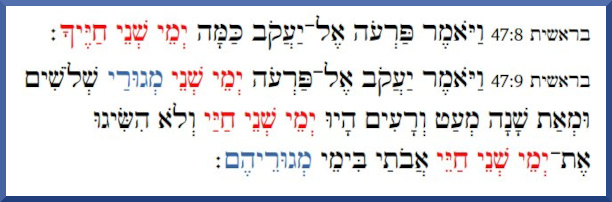
In the above image of the Hebrew text, the words in red are “the days of the years of” followed by the word “life” with different pronoun endings.
The words in blue can be translated as pilgrimage or sojourn.
In the Hebrew, it is clear that Jacob’s answer mirrors the language of the question.
Rashi – Jacob uses the word “pilgrimage” [Hebrew: m’gurai, root gimmel-vav-reish] in his answer. He considered that his entire life he had been a stranger in other lands.
Ramban writes that he doesn’t understand Jacob’s response. Why should he complain to the king? Plus, how could Jacob say that he has “not attained to the days of the years of the life of my fathers”? How could he know that he would live fewer years than Abraham and Isaac?
Ramban concludes that Jacob gave a fairly straightforward answer: I’ve lived 130 and only appear to be so old because my life has been filled with exertion. Therefore, he had turned gray and appeared older than he really was.
Sforno makes clear the distinction between (a) “days of the years of my life” and (b) “days of the years of my pilgrimage.”
According to Sforno, Jacob is saying that his pilgrimage has amounted to 130 years.
But, the “years of life” have been few and evil due to working for food and the events of life. The years of trials and troubles are not called “years of life.”
Jacob continues, that though his fathers had lived as strangers, they still had many “years of life” without troubles. Thus Jacob says the “years of his life” did not reach the “years of life” of his fathers.
Rabbi Hirsch accepts Sforno’s distinction in the phrases, but understands the implication differently. Jacob makes a distinction between living and existing. His existence on earth has been 130 years. But he claims that he has lived very few days.
Jacob thinks he has spent very few days accomplishing his life’s mission. He claims his fathers lived more because every day of their existence was living.
Jacob also says that his mission required him to experience more misfortune than Abraham and Isaac. They were able to fulfill their life mission under conditions of joy.
Genesis 47:10 – Jacob Blesses Again
What was Jacob’s second blessing for Pharaoh?
The text we have does not elaborate on either of Jacob’s blessings. We do find several passages in midrash that go into more detail.
Genesis 47:10:1 – And Jacob blessed Pharaoh. He said, “May [it be God’s will] that the Nile will rise at your feet, and the famine in your land will end soon.”
And what he blessed him at the beginning and the end, was not written, rather to teach you proper behavior, how a man should come before a ruler, and how he should depart from him.
Rashi explains that Jacob blessed Pharaoh in the way anyone would bless a ruler and asked permission to leave. In particular, he blessed Pharaoh that the Nile should rise to his feet. Then the land of Egypt would have the water it needed to survive since that land gets very little rain.
Daat Mikra states that Jacob was fulfilling what God said to Abraham at the end of verse 12:3:
2. And I will make of you a great nation, and I will bless you, and make your name great; and you shall be a blessing;
3. And I will bless those who bless you, and curse him who curses you; and in you shall all families of the earth be blessed.
Further Reading
Genesis 47:7-10 is in parshat Vayigash. You can read a summary of the parsha here.