
God blesses Isaac and tells him to stay in the Land of Israel. He also reveals to Isaac that his father Abraham observed the Torah.
In this article, I’m going to explain Ramban’s comments on Genesis 26:5. Here is that verse with the two preceding verses to provide context:
3. Sojourn in this land, and I will be with you [Isaac], and will bless you; for to you, and to your seed, I will give all these lands, and I will keep the oath which I swore to Abraham your father;
4. And I will make your seed multiply as the stars of heaven, and will give to your seed all these lands; and in your seed shall all the nations of the earth be blessed;
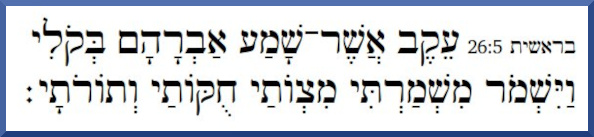
5. Because Abraham obeyed My voice, and kept My charge, My commandments, My statutes, and My laws.
This article is not a translation of Ramban’s comment. Rather, I’m trying to explain his comment. I’ve taken the liberty to skip a couple of his points and also to slightly change the order of some of his points.
Rashi Explains Genesis 26:5
Ramban begins by quoting Rashi on Genesis 26:5 which is based on statements of the Sages:
- obeyed My voice – when I tested him
- My charge – decrees to separate [from sin]
- My commandments – commandments that if they weren’t written in the Torah, then the people would enact them, such as theft and murder.
- My statutes – commandments which the evil inclination or the non-Jews take issue with. Examples are not eating pork and not wearing a mixture of wool and linen. The only reason for these prohibitions is the King has decreed them for his servants.
- My laws – to include the Oral Torah and the commandments given directly to Moses.
Rashi understands that each phrase in the verse refers to a different aspect of God’s commandments. It is not the way of the Torah to use synonyms merely for literary appeal.
Rashi’s comment is based on the tradition that Abraham fulfilled and observed the entire Torah even before it was given to the Jewish people.
Part of this tradition is that Abraham taught the Torah to Isaac. Then Isaac taught Jacob who later taught Joseph. The implication is that the entire family was keeping and observing the Torah.
Ramban’s Questions
Ramban points out some serious questions about this tradition. There are several events recorded in Genesis and Exodus of people doing things that are later forbidden.
No Stone Pillars
The Torah explicitly forbids setting up a stone pillar even when it is meant to serve God.
22. Neither shall you set up a stone pillar which the Lord your God hates.
Yet, Jacob did this two times.
28:18. And Jacob rose up early in the morning, and took the stone that he had put for his pillows, and set it up for a pillar…
35:14. And Jacob set up a pillar in the place where he talked with him, a pillar of stone…
Moses also erected stone pillars:
4. And Moses wrote all the words of the Lord, and rose up early in the morning, and built an altar under the hill, and twelve pillars…
Don’t Marry Sisters
Though the Torah permits a man to marry more than one wife, marrying sisters is prohibited.
18. You shall not take a woman in addition to her sister, to make them rivals, to uncover the nakedness of one upon the other in her lifetime.
But Jacob married Rachel and her sister Leah, as recorded in Genesis 29:16-28.
Don’t Marry Your Aunt
There are two verses that mention the prohibition of marrying your aunt.
18:12. You shall not uncover the nakedness of your father’s sister …
20:19. And you shall not uncover the nakedness of your mother’s sister, nor of your father’s sister …
Amram married his aunt:
20. And Amram took Jochebed his father’s sister to wife; and she bore him Aaron and Moses …
Ramban asks how it is possible that they could have permitted themselves to perform acts that Abraham forbade to himself and God praised him for?
We also know that Abraham taught and commanded his offspring to follow this same path.
Ramban’s Alternate Explanation
Ramban offers an alternative to Rashi’s explanation of Genesis 26:5. He follows a method similar to Rashi’s approach with a major difference.
Ramban suggests that Abraham was being diligent in obeying the seven commandments given to Noah and his descendants.
These are known as the 7 Commandments of the children of Noah or the Noahide Laws. You can read about them here.
- My charge – not practicing “Second Degree” marriages (permitted marriages that are closely related to forbidden marriages).
- My commandments – robbery and murder
- My statutes – not eating a limb from a living animal, not breeding animal mixtures, and not grafting trees.
- My laws – establishing civil laws and not permitting idol worship.
Rashi counted the phrase “obeyed My voice” as one of the categories of commandments Abraham observed. Ramban does not include it on his list. I assume he views the phrase as part of the introduction and would punctuate the verse this way: “Because Abraham obeyed My voice: …”
The advantage of Ramban’s approach is there is no need to claim that Abraham observed Torah laws before they were given and known. These seven commandments were given to Adam and Noah and would have been known to the entire world.
Ramban is suggesting that Abraham was particularly diligent to observe all of the Noahide laws. That is why in the verse he is praised as the one who “kept My charge”.
How Abraham Knew the Torah
Ramban has shown that it’s possible to understand Genesis 26:5 as referring to the Noahide laws that were widely known at his time.
It’s important to note what Ramban has not said about Rashi’s comment.
Sometimes Ramban will attack Rashi and claim that he has either misinterpreted or misapplied statements of the Sages. He has not applied either of those attacks against Rashi on this verse. So far he has raised problems and suggested a different approach to understand the verse.
In this section Ramban will answer the questions he raised earlier. This is an attempt to understand the basis for the claims made by the Sages.
Ramban writes that it seems to him that Abraham learned the entire Torah via divine inspiration (ruach hakodesh). He practiced Torah based on the underlying reasons and foundations for the commandments.
Abraham observed the Torah with the status of a person who knows about commandments but is not obligated to keep them.
Plus, his observance of the commandments was only in the Land of Israel.
Ramban explains that the commandments are the laws of the God of the Land of Israel. Therefore, the forefathers only observed them in the Land of Israel.
That is why Jacob when he was outside the Land of Israel in Padan Aram married two sisters. Similarly, when Amram married his aunt, he was in Egypt.
What applied to our forefathers does not apply to us. Now that the Torah has been given, we are required to observe the applicable parts of the Torah even if we happen to be outside the Land of Israel.
Jacob and the Pillars
The explanation given above does not explain Jacob setting up stone pillars. The first time he did that (Genesis 28:18) he was in the Land of Israel.
Ramban explains that God loved the stone pillars of Jacob and Moses. They were set up with proper motives for the service of God.
Then why does Deuteronomy 16:22 describe stone pillars as those “which the Lord your God hates”? The Canaanites starting building pillars and using them as a basis for idol worship. Due to this perversion, God now hated them, even though He approved of those set up earlier.
Genesis 26:5 – The Simple Explanation
Ramban offers a third explanation of Genesis 26:5, which he labels as “peshat.” We can understand peshat as the simple meaning or plain sense of the text.
- My charge – belief in the oneness of God. Abraham kept this belief alive in his heart and separated from idol worshipers. He also “called upon the name of the Lord” (Genesis 12:8) to draw others to the proper worship of God.
- My commandments – Every thing that God told Abraham to do, he did.
- My statutes – He walked in the way of God being gracious and merciful and performing acts of righteousness and justice. He commanded his offspring in these matters.
- My laws – He circumcised himself and his household and observed all of the Noahide laws.
In this approach, Ramban focuses Genesis 26:5 on the direct interactions between God and Abraham. This differs significantly from the broad approach he suggested earlier of Abraham observing the 7 Noahide laws.
Summary
Ramban offers 3 approaches to understanding Genesis 26:5.
First, he quotes Rashi who, based on the tradition of the Sages, explains how the verse teaches that Abraham knew and observed the Torah hundred of years before it was given.
Next Ramban explains how the verse could be understood as praising Abraham for diligently observing the 7 Noahide Laws.
Ramban concludes with the explanation he prefers. Genesis 26:5 is praising Abraham for his faith in God and doing those things that God commanded him.
Further Reading
Click here for a summary of Parshat Toldot.
This article looks closely at the relationship between Jacob and Esau.