
The Torah records the death of Abraham and just 9 verses later the death of Ishmael. There are lessons we can learn from the wording of these verses.
Let’s look first at the death of Abraham.
Genesis 25:7-8 – Abraham
Here’s how the Torah describes Abraham’s death:
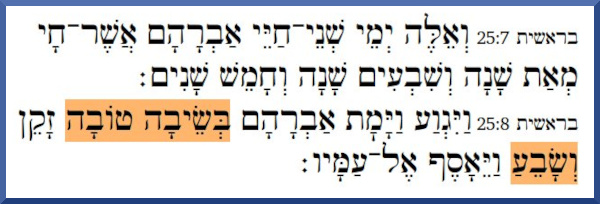
7. And these are the days of the years of Abraham’s life which he lived, one hundred and seventy five years.
8. Then Abraham expired, and died in a good old age, aged and content; and he was gathered to his people.
Abraham died “aged and content.” What is the concept of contentment and satisfaction in the face of death?
Ramban’s Question
Abraham’s old age is mentioned twice in this verse.
The first time is the phrase “in a good old age” [Hebrew: b’seiva tova]. That’s about Abraham’s longevity.
What’s the purpose of the second mention, translated as “aged and content”?
The Hebrew word translated as “content” is v’savei’a. It’s from the 3-letter root sin-bet-ayin.
According to William Holladay (A Concise Hebrew and Aramaic Lexicon of the Old Testament), this root means: be satiated; have had enough, can take no more.
Ramban explains that Abraham saw the fulfillment of all the requests and desires of his heart and was satisfied with all good things.
God’s Blessing
Though Ramban doesn’t mention it, Genesis 25:8 echos back to what was written earlier:
1. And Abraham was old, and well advanced in age; and the Lord had blessed Abraham in all things.
Even then Abraham was blessed “in all things.” The only thing he seemed to lack was a wife for his son Isaac.
Isaac and David
We see a similar idea with Isaac and King David at the end of their lives:
29. And Isaac expired, and died, and was gathered to his people, old and fulfilled [Hebrew: seva, 3-letter root sin-bet-ayin] of days; and his sons Esau and Jacob buried him.
1 Chronicles 29
28. And he [King David] died in a good old age, sated [Hebrew: seva, 3-letter root sin-bet-ayin] with years, riches, and honor; and Solomon his son reigned in his place.
It seems that “sated” [Hebrew seva] applies to all 3 of “years, riches, and honor.”
A Practical Lesson
Ramban writes, all of this (about Abraham, Isaac, and David) teaches us about the kindness of God toward righteous people.
It also teaches us about the positive trait of the righteous that they do not desire excessive luxuries.
This accords with what David wrote in Psalms:
3. You have given him his heart’s desire, and have not withheld the request of his lips. Selah.
The commentary Ramban HaMevoar understands the verse this way: What You have given him is what he desires. For he does not have any desire for anything that he has not received.
This is in stark contrast to most people:
9. He who loves silver shall not be satisfied with silver …
The midrash explains this verse:
13. … A person does not leave the world and half of his desires in his hand. If he has 100, he wants to turn it into 200. If he has achieved 200, he wants to turn it into 400.
God’s Promise to Abraham
I want to take this idea back to an even earlier time in Abraham’s life. At the Covenant Between the Parts, God tells Abraham:
15. And you shall go to your fathers in peace; you shall be buried in a good old age [Hebrew: b’seva tova].
The words b’seva tova used here are the same words used when Abraham died.
It’s clear that not all of Abraham’s life was peaceful. He faced many challenges and was tested by God.
However, it appears that after he found a wife for Isaac (Genesis 24) the rest of his life was tranquil and full of peace.
Genesis 25:8 and 17 – Expired and Gathered
Now let’s look at another lesson from the deaths of Abraham and Ishmael.
Here are the verses that describe their deaths:
8. Then Abraham expired, and died in a good old age, aged and content; and he was gathered to his people.
17. And these are the years of the life of Ishmael, one hundred and thirty seven years; and he expired and died; and he was gathered to his people.

Two times in Genesis 25 death is described as “expired.” What is the importance of this word in this context?
And He Expired – Vayigva
The word “expired” in these verses is the translation of “vayigva” from the 3-letter root gimmel-vav-ayin.
According to A Concise Hebrew and Aramaic Lexicon of the Old Testament, this word has these meanings: expire (breathe ones last); die.
The Etymological Dictionary of Biblical Hebrew, based on the writings of Rabbi Samson Raphael Hirsch, adds the idea of “die without suffering.”
Both Rashi and Ramban write about the concept of “expiring” in their comments on Genesis 25:17 about the death of Ishmael.
Rashi Explains Genesis 25:17
and he expired [Hebrew: vayigva] – the word expired [g’vi’a] is only used with righteous people.
Rashi is teaching us that Ishmael was considered a righteous man when he died.
He was not righteous when he was young.
16:12. And he [Ishmael] will be a wild man; his hand will be against every man, and every man’s hand against him; and he shall live in the presence of all his brothers.
21:20. And God was with the lad [Ishmael]; and he grew, and lived in the wilderness, and became an archer.
Rashi on Genesis 16:12 writes that “his hand will be against every man” means that he will become a bandit.
Then on 21:20 Rashi explains that he “became an archer” means that Ishmael used his skills with bow and arrow to accost and rob people.
Ramban in his commentary on these phrases does not mention any disagreement with Rashi.
Ramban Disagrees and Explains
Ramban begins his commentary by quoting Rashi and pointing out that the Gemara rejects the idea that “expired” is only used with righteous people.
The Gemara’s rejection is based on the Generation of the Flood.
21. And all flesh died [Hebrew: vayigva] that moved upon the earth, … and every man.
If these were righteous people, then God would not have destroyed the world with a flood!
In addition, the same word is used to describe the death of the generation of Jews who died in the wilderness.
3. And the people quarreled with Moses, and spoke, saying, Would God that we had died [Hebrew: gimmel-vav-ayin] as our brothers died [Hebrew: gimmel-vav-ayin] before the Lord!
Expired and Gathered
The Gemara concludes that the death of righteous people is described using two words: expired [Hebrew: g’vi’ah] and gathered [Hebrew: asifa].
Ramban explains that g’vi’ah means the person died without experiencing sickness, pain, or suffering.
The generation of the Flood and the generation in the Wilderness all experienced a quick death, not at the hand of man, but at the hand of Heaven. Hence, their death is characterized as g’vi’ah.
But, when the word g’vi’ah is combined either with asifa (gathered) or yamat (died) the verse is indicating that the person was righteous.
Conclusion
From my research, the combination g’vi’ah with asifa or yamat is only used in relation to five individuals:
- Abraham – Genesis 25:8
- Ishmael – Genesis 25:17
- Isaac – Genesis 35:29
- Jacob – Genesis 49:33
- Aaron – Numbers 20:29
(I do not know why this phrasing in only found in the Torah. It would seem to be appropriate when other deaths are described. For example, there were righteous kings such as David, Solomon, and Hezekiah.)
Ishmael is the one person on the above list who doesn’t seem to belong. For some reason it was important for the Torah to teach us that Ishmael was a righteous man.
Perhaps the lesson is that no matter what a young person did, there is still the possibility of repentance and being accepted in Heaven as a righteous person.
Further Reading
Click here for a summary of Parshat Chayei Sarah.
Abraham needs a burial place for Sarah. But what’s his status with the local residents?