
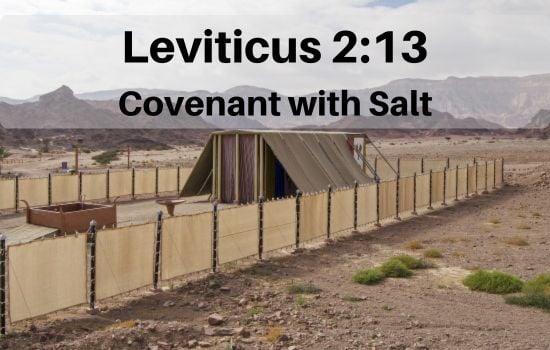
Leviticus 2:13 states that every offering in the Temple must be brought with salt. And that God made a covenant with salt. What is the nature of this covenant?
Here is the relevant verse:
13. All your meal offerings you shall salt with salt; and you shall not withhold the salt of the covenant of your God from upon your meal offering. On all your offerings you shall bring salt.
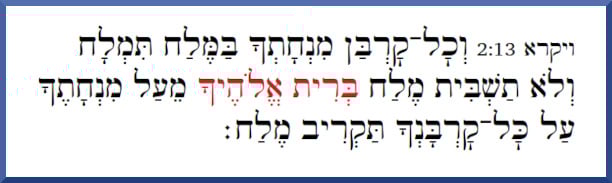
Ramban begins his commentary on Leviticus 2:13 by quoting Rashi and Ibn Ezra.
Rashi on Leviticus 2:13
salt of the covenant – The covenant was made with salt during the 6 days of creation. God promised the lower waters that it would be brought on the altar as salt and [also as] the water libation during Sukkot.
Rashi is citing a midrash that refers to the second day of creation.
7. And God made the firmament, and divided the waters which were under the firmament from the waters which were above the firmament; and it was so.
There is a Jewish tradition that the lower waters, those under the firmament, complained that they were being separated from God’s presence. So God promised them that they would play a significant role in the Temple service.
Ramban quotes Rashi and then adds, “It is a midrash of our rabbis.”
It seems to me that Ramban doesn’t think this midrash adequately explains the verse.
Ibn Ezra Explains
Ramban then introduces Ibn Ezra’s comment as being according to the plain meaning (peshat) of the verse:
the covenant of your God – I brought you [the Jewish people] into the covenant and I made you swear that you would not bring an unseasoned and inedible offering because that is a contemptible thing.
According to Ibn Ezra, the covenant is not with salt. It is with the Jewish people that they must include salt with all of their offerings.
He writes that an unsalted offering is “a contemptible thing.” Why? Maybe because a person would not offer a ruler or dignitary unseasoned food?
The Gemara (Sukkah 50a) makes a similar point about bringing a blind or lame animal as an offering. The Gemara asks, “Would you present it to your governor?” Of course not, so don’t offer it to God on the altar.
The Model Covenant
Ramban states in a sense this is the “first” covenant and, therefore, the model for other covenants. There are also these covenants that mention salt:
Gifts to the priests:
19. All the offerings of the holy things, which the people of Israel offer to the Lord, have I given you, and your sons and your daughters with you, by a statute forever; it is a covenant of salt forever before the Lord to you and to your seed with you.
The dynasty of King David:
5. Ought you not to know that the Lord God of Israel gave the kingdom over Israel to David forever, to him and to his sons by a covenant of salt?
Just like the covenant of salt with the offerings is permanent, these covenants with the priests and the Davidic dynasty are permanent.
Ramban Dives Deeper
Ramban begins this section of his commentary by pointing out that Leviticus 2:13 says “covenant of your God,” but not “covenant of the Lord.”
We would have expected “covenant of the Lord” since that is the divine name used in relation to the offerings.
In Leviticus chapters 1-5, God’s 4-letter name appears 59 times. This is the Tetragrammaton (Hebrew: yud-hey-vav-hey) often translated as Lord.
God’s name “Elohim” appears only 2 times: in this verse and later in Leviticus 4:22 about the sin offering of a ruler. In that verse, the name “Elohim” is in relation to the commandments, not to the sin offering.
The Tetragrammaton is the only one of God’s names associated with the offerings.
Therefore, Ramban suggests that the “salt” mentioned here is actually water that carries within it salt. Then the sun causes the water to evaporate and leave behind the salt.
The water in its beginning nourishes the earth, fertilizes, and causes it to sprout.
From the commentary Ramban HaMevoar, Ramban is referring to this verse:
10. For as the rain comes down, and the snow from heaven, and returns not there, but waters the earth, and makes it bring forth and bud …
But then the sun beats down on the water and turns it into salt that nothing else can grow in.
22. And that the whole land is brimstone, and salt, and burning, that it is not sown …
In summary, salt in small quantities is beneficial. In large quantities it can kill plants.
Salt and Covenant
Ramban now explains the connection between salt and covenants.
A covenant includes within it all attributes of how God manages the world.
In particular, God manages the world with the attributes of mercy and justice.
Rashi on Genesis 1:1 notes that verse says “God created” but not “the Lord created.”
He explains that God’s original plan (as it were) was to create the world and have it controlled by the attribute of justice. That is represented by God’s name “Elohim” and why it appears in Genesis 1.
But God knew that the world needed mercy. This attribute is represented by the Tetragrammaton (Hebrew: yud-hey-vav-hey). Therefore, starting in Genesis 2, the name Lord is introduced.
Salt has within it the attributes of mercy and justice. As Ramban explained, salt comes from water which represents the attribute of mercy. But the sun evaporates the water leaves behind a destructive residue of salt. The sun is a fire which represents the attribute of justice.
Salt is similar to a covenant.
Salt has the ability to give flavor to food and to act as a preservative. But, when something is over salted it is ruined and no longer edible. In other words, salt can preserve or destroy.
Also a covenant can preserve or destroy. A covenant contains within it the attribute of mercy [preservation of what is good] and also the attribute of justice [destruction].
We see this in the 3 covenants with salt: the offering (Leviticus 2:13), the gifts to the priests (Numbers 18:19), and King David’s dynasty (2 Chronicles 13:5).
The covenant of the offerings is to preserve the world but destroy those who transgress.
In the similar way, the covenant of salt made with the priests and King David includes the power to preserve and do good as well as the power to destroy.
Rabbi Steinsaltz explains the concept of using a physical object as part of a covenant. I think his summary is along the lines of what Ramban is saying:
“In the ancient world, covenants were made using items that symbolized endurance or by performing acts that symbolized the fate of one who breaks the covenant, e.g., slaughtering animals or melting wax.”
Salt, with its ability to preserve or to destroy, symbolizes both aspects of a covenant.
Further Reading
Click here for a summary of Parshat Vayikra.
Many times the Torah writes that an offering burning on the altar is a “sweet smell” or “pleasing aroma” to God. This article explains this puzzling phrase.