
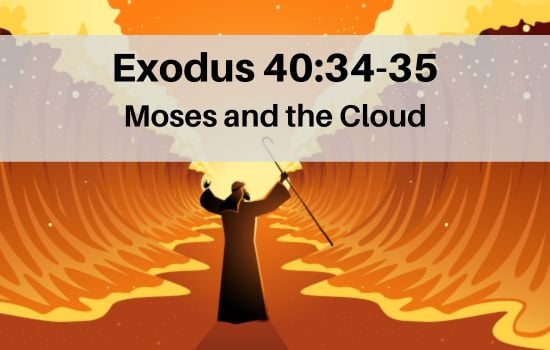
At the conclusion of the Book of Exodus, Moses sets up the tabernacle and a cloud covers it. God then calls to Moses and he enters the tabernacle. Or, maybe he doesn’t. Ramban explains.
Here are the verses about a cloud covering the Tent:
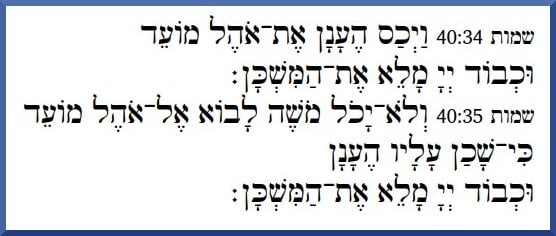
34. Then the cloud covered the Tent of Meeting, and the glory of the Lord filled the tabernacle.
35. And Moses was not able to enter into the Tent of Meeting, because the cloud abode on it, and the glory of the Lord filled the tabernacle.
Ramban Explains
Let’s start by looking at how Ramban explains the basic facts of these two verses.
Then the cloud covered the Tent of Meeting – the cloud covered the Tent from every side so that it was covered and hidden in it.
The word “covered” could have been understood to mean that the cloud was only on the Tent’s top.
and the glory of the Lord filled the tabernacle – That is, glory of the Lord filled the inside of the tabernacle. Because “the glory” was inside the cloud that was in the midst of the tabernacle. This is similar to what is stated about God’s presence at Mount Sinai:
18. … Moses drew near to the thick darkness where God was.
Ramban explains that the glory of God’s presence at Mount Sinai dwelled in the midst of the darkness.
And Moses was not able to enter into the Tent of Meeting – The phrase “not able to enter” is from the Hebrew words “lo yachol lavo el.”
Most English translations I have seen translate this as “not able to come into” or “not able to enter.”
Ramban understands the Hebrew to mean “not able to come to” and then he adds, “even to the door, because the cloud had covered it and he did not have permission to come into the cloud.”
In other words, the verse isn’t about Moses not being able to enter into the tabernacle. Rather it’s about the cloud preventing him from even approaching the Tent of Meeting.
Rabbi Shraga Silverstein in The Rashi Chumash is the only translation I’ve seen that agrees with Ramban’s reading of the Hebrew.
35. And Moses could not come to the tent of meeting, for the cloud rested upon it and the glory of the Lord filled the mishkan.
Ramban’s Second Point
Ramban adds that another reason Moses could not enter the Tent of Meeting was because the glory of the Lord filled the tabernacle.
According to Ramban, the phrases
- the cloud covered the Tent of Meeting
- the glory of the Lord filled the tabernacle
teach us two distinct reasons why Moses was outside the Tent. Because of the cloud, he could not get near the entrance. Also, even if he could get to the entrance, the glory of Lord would prevent him from actually entering.
But Moses Did Enter!
Ramban writes that the real reason why Moses could not enter the Tent of Meeting is because he was not granted permission to enter into the cloud.
But, when he was called, then he could enter.
This is similar to what happened at Mount Sinai.
16. And the glory of the Lord abode upon Mount Sinai, and the cloud covered it six days; and He called to Moses on the seventh day from the midst of the cloud.
…
18. And Moses went into the midst of the cloud …
After God called to Moses and granted him permission to enter, Moses went up and spent 40 days and nights on Mount Sinai.
Maybe Moses Never Entered
Ramban suggests that the straightforward (peshat) reading of Exodus 40:34-35 is that Moses never entered the Tent of Meeting to speak with God.
This is supported by the first verse of the Book of Leviticus:
1. And the Lord called to Moses, and spoke to him from the Tent of Meeting …
According to Ramban, we can conclude that God called to Moses from the Tent of Meeting while Moses stood outside at the entrance.
A Midrash Disagrees
Ramban quotes a midrash (Sifra, Beraita DeRabbi Yishmael 18) that claims Moses could enter the Tent of Meeting when he wanted to, even without being called.
The midrash makes this claim based on resolving a contradiction between two verses.
Our verse, Exodus 40:35, states that “Moses was not able to enter into the Tent of Meeting …”
But there is another verse which states the opposite:
89. And when Moses went into the Tent of Meeting to speak with Him …
The midrash understands that Numbers 7:89 means that Moses could go into the Tent of Meeting even without being called whenever he wanted.
The midrash resolves the contradiction by stating that whenever the cloud was on the Tent of Meeting, then Moses was not able to go in. But if the cloud was not on the Tent, then Moses could go in even without being called.
Ramban Explains the Midrash
Ramban offers an alternate basis for the midrash. He begins by quoting the continuation of the verse from Numbers 7 that was not quoted by the midrash:
89. And when Moses went into the Tent of Meeting to speak with Him, then he heard the voice speaking to him from the cover …
Ramban suggests that the author of the midrash understands from this verse that Moses was standing in the Tent of Meeting. But, whenever “the glory of the Lord filled the tabernacle” then Moses could not go in there.
When the cloud would lift off from covering the Tent of Meeting, then Moses could enter. According to the midrash, that would mean he could enter without being called.
Yet Another Explanation
Ramban is bothered by the repetition of the phrase “and the glory of the Lord filled the tabernacle.”
Ramban writes that the second mention of the phrase hints at the idea that a bit of the glory of the Lord was always present in the tabernacle, even after the cloud lifted off the Tent of Meeting.
The commentary Ramban HaMevoar explains that Ramban is connecting the tabernacle to what happened at Mount Sinai.
That is, the glory of the Lord appeared at Mount Sinai. God’s intention was that His glory should also dwell in the tabernacle, but in a hidden and not always obvious way.
It seems to me, based on this, that Ramban would continue to claim that Moses only entered the tabernacle when God called him. That would also imply that most of the times when God spoke to Moses from the Tent of Meeting, Moses was standing outside.
Further Reading
Click here for a summary of Parshat Pekudei.
Near the end of Exodus we are told that the Tabernacle was completed and that the work was done. What is the purpose of this repetition?